
SouthWest engineers top poll
Brunel and Dyson beat Bill Gates and Steve Jobs as biggest engineering pioneers in GE survey
The SouthWest is home to the most inspiring engineers in the world, according to a poll of UK engineering students. the survey by General electric shows that engineering appeals to a new generation of young minds and that the impact on society is seen as a bigger influence than salary and career. Asked the question, “Who do you consider to be your hero/icon in your field?” students gave a fascinating range of answers, from well-known historical figures such as Brunel, Einstein and Newton, to modern day technology icons such as Steve Jobs and James Dyson. Brunel and Dyson, both from the SouthWest, top the poll ahead of the US entrepreneurs.
The Top 10 Engineering Heroes are:
- Isambard Kingdom Brunel – leading civil engineer of 19th Century, built bridges, dockyards and railways.
- James Dyson – industrial designer who developed a new generation of vacuum cleaners and actively supports engineering projects in the UK.
- Steve Jobs – co-founder and CEO of Apple Inc., which developed some of the most iconic personal technology products including the Mark II computer and iPod.
- Nikola Tesla – inventor and engineer whose work formed the basis of modern alternating current electric power systems.
- Bill Gates – co-founder and Chairman of Microsoft, who developed the industry standard operating system for personal computers.
- Frank Whittle – RAF engineer who is credited with inventing the first jet propulsion engine.
- Isaac Newton – physicist and theoretician who developed the concepts of mechanics, gravity and the laws of motion and invented the reflecting telescope.
- Albert Einstein – theoretical physicist who developed the theory of general relativity and is considered the founder of modern physics.
- Charles Rolls & Henry Royce – developed early engine technology and luxury motor vehicles.
- Thomas Edison – inventor of the first commercially viable light bulb, motion picture camera and phonograph who revolutionised electrics and communications.
“Our research shows that iconic figures – both historic and modern – continue to inspire a new generation of engineers,” said Mark Elborne, President and CEO of GE UK. “We continue to see the impact of these icons all around us today; and our research shows that we have a proud tradition of pioneers and innovators in this country, which should be celebrated. With the very significant environmental, energy and healthcare challenges we face today and will face in the future, it is critical that we continue to inspire young people into engineering and science, nurturing future generations of Brunels, Newtons and Edisons.”
The research also looked at the innovations that most inspired this new generation of engineers, with the top five being:
- Computers and Electronics
- Communications Technology
- Transportation Technology
- Power and Energy Technology
- Manufacturing and Materials
The GE Young Minds Monitor also looked at what students saw as the biggest challenges that engineering technology should look to address:
- Energy
- Environment
- Food, Water and Natural Resources
- Societal Issues
- Quality of Education
The study indicated that young people are increasingly positive about the prospects of engineering technology in the UK. 92% of students say that engineering technology has a “positive image” and the same number was confident or very confident about their career prospects on graduation.
“In today’s celebrity obsessed culture, there is a risk that engineering will not be seen as particularly trendy,” said Elborne. “However it is crucial to our economic growth and prosperity; to our international competitiveness as well as to our future. It is refreshing to see that a new generation is turning toengineering – not just because of the career or salary prospects, but because engineering gives them the skills and tools to address some of the world’s biggest challenges. This in itself is inspiring and very encouraging.”
Both lecturers and students see developing a more positive societal attitude regarding the benefits of engineering (86% and 77%) and investment in higher education and vocational training (82% and 64%) as the most important ingredients for developing a best in class engineering technology culture in the UK.
Related articles
- James Dyson: Reinventing Britain (guardian.co.uk)
- Steve Jobs Ranked Third in Engineering Heroes List (pcworld.com)
- Design and technology must survive the curriculum review – Dyson (guardian.co.uk)
- Dyson: The corridors of brain power (independent.co.uk)

SouthWest celebrates 50 years of the silicon microchip
The SouthWest figures heavily in the 50th anniversary of the microchip this week, says SiliconSouthWest.
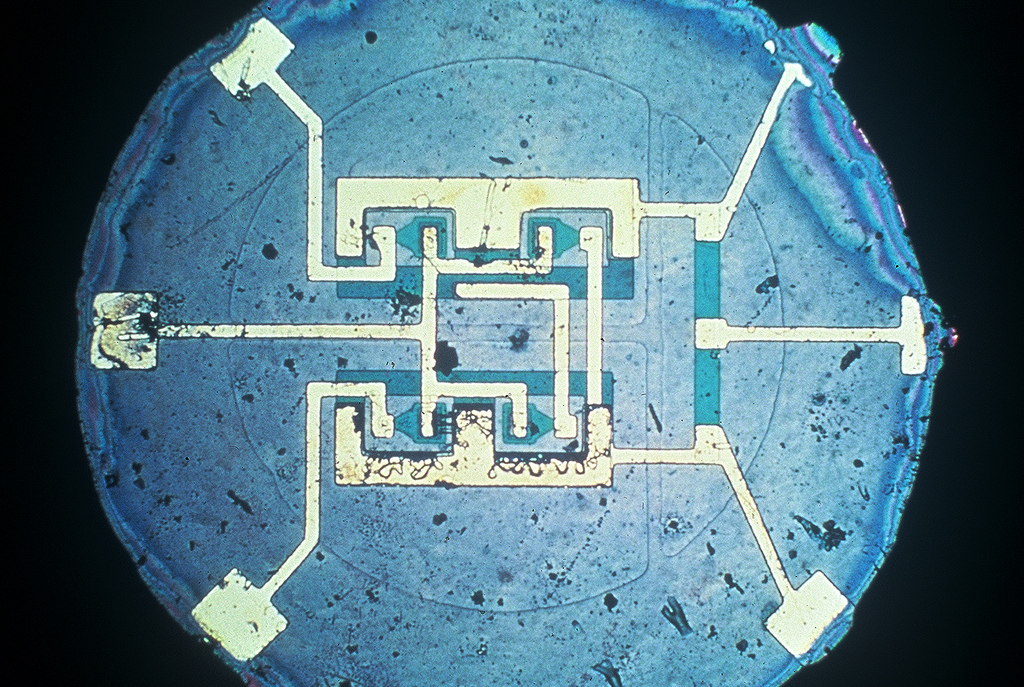
The first silicon IC at Fairchild in 1961
The silicon integrated circuit (IC, left) as we know it was patented by Fairchild Semiconductor’s Robert Noyce who received the first patent for a commercially available silicon IC on the 25th of April 1961. Plessey Semiconductor in Swindon was developing a silicon chip at the same time following the first chip (in a different technology) shown by Texas Instruments a few years earlier in 1958. Fairchild set up in Swindon in 1972, with Intel close by in 1974.
The National Microelectronics Institute (NMI) highlights the current state of the art for microchip technology with SouthWest activity from the University of Southampton, Toumaz in Oxford, Imagination Technology in Chepstow, Dialog Semiconductor in Swindon and Plessey Semiconductors in Plymouth and Swindon.
The UK is home to over 40 per cent of Europe’s independent electronic design community and its 11,500 companies and 250,000 people form an ecosystem worth £23 billion per year to the British economy, with the largest cluster of silicon designers here in the SouthWest. “You only have to look inside your mobile phone to see the British contribution,” said Dr Derek Boyd, head of the NMI. “You will likely find an ARM processor, a CSR Bluetooth and GPS chip, a Dialog Semiconductor power management device and an Imagination Technologies graphics core.”
“The UK’s microelectronics sector continues to be at the forefront of this innovation,” said Dr Boyd. “UK based researchers, technologists and manufacturers are creating chips and systems capable of genetic disease detection, determining the build up of pollutants in the oceans, emitting light that sterilises drinking water or medical instruments, analysing the structural integrity of high-speed rail lines, and the early identification of injuries in racehorses.”
- A chip capable of detecting single nucleotide polymorphisms (SNPs) inDNA has been developed which gives results in minutes – DNA amplification, sequencing and analysis typically takes days. The device can be configured to detect any SNP, making it applicable to medicine, agriculture and pharmacology. The technology has been developed by Professor Chris Toumazou, founder and CEO of Toumaz Technologies and DNA Electronics.
- Researchers at Southampton University have created a chip to detect nutrients and pollutants at the ultra low concentrations found in the ocean. Developed in collaboration with the National Oceanography Centre, the ‘labon chip’ is capable of capable of measuring temperature, salinity, and the concentrations of nitrites, nitrates, phosphate, iron and manganese
- Plessey Semiconductor, in collaboration with Cambridge University, is developing an LED (light emitting diode) that uses Gallium Nitride to releaselight at wavelengths lethal to bacteria – 265nm. The low cost technology will be made available during this decade and be powered by solar cells. Plessey believes it will be adopted in developing economies or disaster zones to create clean drinking water, and in the developed world to replace chlorine sterilisation methods. Additional uses include the sterilisation of medical instruments.
- Accelerometer chips are being developed at the University of Southampton that, among other applications, are capable of detecting weaknesses in high-speed rail networks. The highly sensitive chips monitor how a section of track behaves whilst a train is on it. Any changes in behaviour can be used to determine changes in its structural integrity.
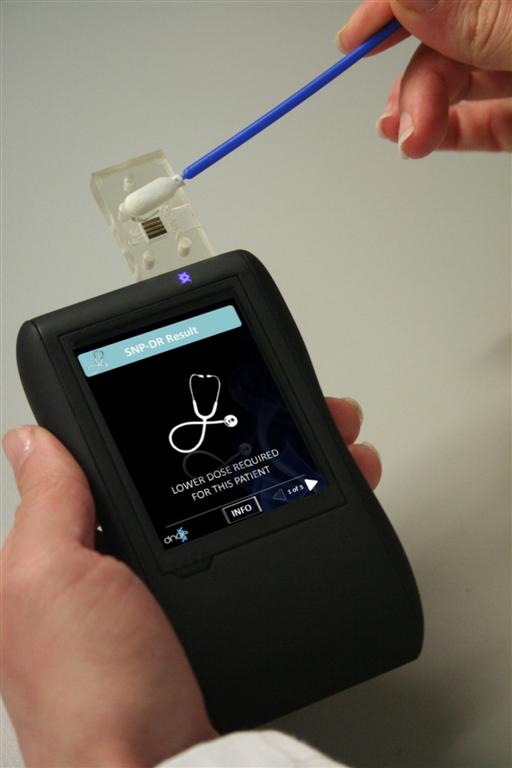
DNA test on a chip
The NMI has also highlighted transport, digital media, communications, healthcare and smart energy grids as key growth areas for the electronics industry, all strong areas for the SouthWest.
Related articles
- Intel chips grow up; Company says 3-D transistors will allow for microprocessors that are smaller, faster and more efficient (bendbulletin.com)
- Intel to use vertical FINFET transistors in chips by year end – video and update (The Embedded Blog)

New online mechanism for electric vehicle charging protects the Grid
Researchers at the University of Southampton have designed a new pricing mechanism that could change the way in which electric vehicles are charged. It is based on an online auction protocol that makes it possible to charge electric vehicles without overloading the local electricity network.
The paper – Online Mechanism Design for Electric Vehicle Charging – was presented this week at AAMAS 2011, Tenth Conference on Autonomous Agents and Multiagent Systems, and outlines a system where electric vehicle owners use computerised agents to bid for the power to charge the vehicles and also organise time slots when a vehicle is available for charging.
“Plug-in hybrid electric vehicles are expected to place a considerable strain on local electricity distribution networks. If many vehicles charge simultaneously, they may overload the local distribution network, so their charging needs to be carefully scheduled,” said Dr Alex Rogers, University of Southampton computer scientist and one of the authors.
To address this issue, Dr Rogers and his team turned to the field of online mechanism design. They designed a mechanism that allows vehicle owners to specify their requirements (for example, when they need the vehicle and how far they expect to drive). The system then automatically schedules charging of the vehicles’ batteries. The mechanism ensures that there is no incentive to ‘game the system’ by reporting that the vehicle is need earlier than is actually the case, and those users who place a higher demand on the system are automatically charged more than those who can wait.
“The mechanism leaves some available units of electricity un-allocated. This is counter-intuitive since it seems to be inefficient but it turns out to be essential to ensure that the vehicle owners don’t have to delay plugging-in or misreport their requirements, in an attempt to get a better deal,” said Dr Enrico Gerding, the lead author of the paper.
In a study based on the performance of currently available electric vehicles, performed by Dr Valentin Robu and Dr Sebastien Stein, the mechanism was shown to increase the number of electric vehicles that can be charged overnight, within a neighbourhood of 200 homes, by as much as 40 per cent.
The research follows on from Dr Rogers’ and Professor Nick Jennings’ work on developing agents that can trade on the stock market and manage crisis communications and Dr Rogers’ iPhone application, GridCarbon for measuring the carbon intensity of the UK grid.
Related articles
- Electric vehicles ‘may be costlier’ (autonetinsurance.co.uk)
- Fast charging station for electric vehicles (physorg.com)
- New iPhone App for EV Drivers (energyrefuge.com)
- What BMW Really Thinks About Electric Vehicles (fastcompany.com)
- GE to Buy 25,000 Electric Vehicles (brainz.org)

Atego acquires US avionics specialist
Combining the regions software and avionics skills, Cheltenham-based software tools supplier Atego has bought a US avionics software specialist called HighRely.
Atego is the leading independent supplier of industrial-grade, collaborative development tools that are used for developing complex, mission-critical and safety-critical systems, from the architectures to the software and hardware.
“The acquisition of HighRely is all about scale, growth and continuing to deliver on our Work-as-One strategy to enable engineers to easily meet the difficult challenges involved in designing complex, critical systems,” said James Gambrell, Chairman of Atego. “HighRely’s expertise in the aerospace and avionics markets adds considerable breadth and depth to our solutions and services for critical system design and development, reinforcing our position in the market and boosting our potential for growth. The unparalleled industry knowledge, expertise and ongoing commitment of HighRely’s employees will also add significantly to our global expansion plans. This acquisition is key for Atego and we plan to invest in the growth of the HighRely business, while continuing to service HighRely’s loyal customers”
Based in Phoenix, Arizona, HighRely supplies tools for developing aerospace and avionics systems, medical equipment, nuclear and transportation systems, covering the whole project lifecycle from application planning, specification and design through to build, testing, verification, certification and implementation. It has North America’s largest Avionics Certification Centre and provides more certified avionics engineers than any other services company. HighRely’s engineers have worked on over 60% of all major commercial and military aircraft developed in the past decade.
“Atego has an enviable reputation for providing robust products and services for complex, critical system and software development,” added Vance Hilderman, President of HighRely. “Our tools and services are the perfect complement to Atego’s highly successful, market-leading solutions portfolio and our skill-base will provide added impetus for growth in Atego’s key market segments.”
Under the terms of the agreement with HighRely, Atego is acquiring the company and all its assets, including service offerings, products and intellectual property. The acquisition will see all of HighRely’s employees, Phoenix headquarters and Avionics Certification Center, ongoing customer commitments and partner relationships integrated into Atego’s global business operations.

Bath scientists find ‘switch’ that could help design new vaccines and treatments for auto-immune diseases
Researchers at the University of Bath have determined a new structure of an important complex in the human immune system that could be the key to designing vaccines and treatments for autoimmune diseases such as Multiple Sclerosis (MS).
Dr Jean van den Elsen of the University of Bath and Dr David Isenman of the University of Toronto show how a new understanding of the structure of this immune system complex has important medical implications. An atomic structure of the complex, which is key to the development of immunity against microbial pathogens and a potential target for the treatment of autoimmune diseases such as MS and SLE, was first published in Science in 2001, but it was recently determined to be incorrect by the two researchers.
Dr van den Elsen and Dr Isenman have spent a decade studying the complex and decided to reanalyse its structure to develop a correct understanding of its atomic details. “The research looks at a complex between two proteins, one from the complement system – a part of our innate immune system that is present from the beginnings of our lives – and another from the adaptive immune system,” said Dr van den Elsen. “It has become understood in recent years that the complement system also has a role in ‘kick-starting’ the adaptive immune system – the part of our immune system that reacts to pathogens as we are exposed to them, by developing antibodies.”
The researchers focused on a particular protein, C3, in the complement system and its molecular partner complement receptor 2 (CR2) on the surface of B cells, the antibody producing cells of the adaptive immune system.
C3 breaks down to produce a fragment called C3d when attached to a pathogenic antigen which is then able to act as a ‘bridge’ between the innate and adaptive immune systems by connecting the antigen recognition entity of the B cell (the B cell receptor, BCR) with the complement receptor.
This then boosts the immune system by increasing the production of antibodies that attack the pathogen.
The interaction between C3d and CR2 therefore acts to increase the sensitivity at which a pathogen is recognised and reacted to in the body, which is essential in keeping us healthy from disease.
This characteristic has important implications for the design of new vaccines against diseases caused by microbial pathogens
However, this process can go wrong, with the immune system mistaking a part of the body as a pathogen and attacking it, resulting in an autoimmune disease.
Dr Isenman said: “To treat antibody-mediated autoimmune diseases there is a potential to target the ‘bridging’ action of C3d with CR2, through designing drugs that would inhibit the interaction.
“However, due to the misunderstandings caused by the previous structure of the complex, over the past ten years progress in this field has been delayed.”
The findings will end a decade-long controversy regarding the structure of this important part of the immune system, and marks a turning point in science’s ability to develop treatments for a subset of autoimmune diseases.
Dr van den Elsen said: “The new structure is very different to the previous one, but its features conform to all existing biochemical data.
“With the issues relating to the structure of this complex now resolved we hope to take our research forward and use this as a platform to design inhibitory compounds that may be useful in treating antibody-mediated autoimmune diseases.”
The authors of the current study recognise that this goal will not be easy to achieve and that there is a great deal of research still to be done.
However, this discovery is a key milestone in the development of a treatment for antibody-mediated autoimmune diseases and the structural scaffold on which all future progress is based is now firmly in place.
Related articles
- Understanding Autoimmunity (everydayhealth.com)

£2 million for brain research in Bristol
A University of Bristol academic has been awarded over £2 million by the Medical Research Council (MRC) to look into the neural network basis of learning, memory and decision-making in health and disease.
The majority of the grant will fund Dr Matt Jones’ MRC Senior Non-clinical Research Fellowship, entitled ‘Control of neuronal networks and cognitive behaviour by deep brain, transcranial and optogenetic stimulation’.
“Your brain is constantly doing sums, weighing-up past experience and the current situation in order to decide how best to behave. Unfortunately, patients with brain diseases like schizophrenia have trouble coping with these decisions that most of us take for granted. Electrical activity in different parts of their brains becomes subtly uncoordinated, making it difficult to see the wood for the trees,” said Dr Jones, Senior Research Fellow in the University’s School of Physiology and Pharmacology.
“This project will use stimulation techniques designed to control the brain’s electrical signalling (very carefully – you wouldn’t notice if it was done to you) to see if we can re-coordinate brain activity at important times such as during decisions and therefore improve cognitive performance,” he said.
In a second MRC-funded project led by co-applicants Professors Lawrence Wilkinson, Mike Owen and Mick O’Donovan of Cardiff University, Dr Jones’ lab will contribute to a study of schizophrenia risk genes. Understanding the genetic basis of the disease is central to designing new therapies.
Dr Jones said: “This is a fantastic opportunity to unite the internationally recognised strengths of Cardiff and Bristol’s geneticists and neuroscientists. This project evolved from a pilot funded by the Severnside Alliance for Translational Research (SARTRE), and we are delighted that the MRC continues to recognise what hotbed of translational neuroscience Bristol and Cardiff represent.”
Related articles
- Brain function linked to birth size in groundbreaking new study (eurekalert.org)

New buyer sees rebirth of Bristol Cars at Filton

Kamkorp Autokraft, part of the Frazer-Nash group, has acquired the assets and goodwill of Bristol Cars, the luxury car manufacturer, from its administrators. This acquisition will re-establish the connection between Bristol Cars and Frazer-Nash which dates back to Frazer-Nash’s close involvement in the foundation of Bristol Cars 65 years ago.
“Bristol Cars is a British institution and an important part of our national motoring heritage,” said William Chia, the group’s Director of Operations. “Over the next few months we will start to reveal the details of our plans to combine Bristol Cars’ tradition and iconic marque with Frazer-Nash’s pioneering technology to showcase our cutting-edge electric and range-extended powertrains. British engineers are globally recognised for their inventions and the quality of their innovation – and these attributes are inherent in all our systems and products. Mindful of Bristol Cars’ rich heritage and our responsibility as custodians of the brand, we are certain that our technology will blend seamlessly and successfully with the Bristol Cars tradition of engineering integrity.”
Bristol Cars, which has its factory at Filton, is the only luxury car manufacturer that remains in private British hands, which the company says gives absolute independence of thought and action that is essential. Despite the small production volume it offers four distinct models covering a wide range of styles and functions. The Fighter and Blenheim remain the primary offerings, while the Speedster and its new cousin the Roadster, which offers a folding top and two plus two seating, continue – in very small numbers and to special order.
The Series 6 range is not strictly new as it is based on an older classic donor car but combines a restoration with extensive modifications that incorporate modern electrics and powertrain. Interestingly, although the Series 6 option (using the same technology and running gear as the Blenheim 3) was originally offered only for the 411, the company is producing both 410 and 603 Series 6 variants and expects to build a 412 Series 6.
In order to serve the demand for ‘as new’ versions of classic cars it is currently starting the build of a 405 drop-head with an uprated 6 cylinder engine and with a steel body frame instead of the original wood. This will not only ensure its longevity but ensure that it cannot be confused with a 1950s production version.
The company’s roots are from the end of World War II when the Bristol Aeroplane Company was faced with the problem of how to use its excess capacity and keep its many employees busy.
In 1960 it was persuaded to join with others to form the British Aircraft Corporation (later British Aerospace). At that time the car division (Bristol Cars Ltd) passed into private hands but the staff are still deliberately drawn from an aviation background at Filton.
Related articles
- Bristol Cars, the British motoring institution, goes into administration (telegraph.co.uk)

Bristol wins £2m centre for 3D printing
R&D collaboration for aircraft and cars
Aircraft maker EADS and GKN Aerospace are launching a £2m research centre to examine industrialising the next generation of manufacturing process known as Additive Layer Manufacturing (ALM), which is essentially ‘printing’ objects in 3D. The collaboration will be supported by a £1.96m investment provided through a Government Regional Growth Fund grant for the use of ALM in aerospace but also for making parts and accessories for cars. The project will be based in a new shared facility at Filton in Bristol and is expected to create up to 30 new sustainable engineering jobs and develop a new supply chain of companies in the region. “Promoting innovation is vital if we are to drive growth in our local communities,” said Business and Enterprise Minister Mark Prisk. “We have received a large number of ambitious and highly competitive bids to the first round of the Regional Growth Fund, which will help a number of businesses across the country, and I am delighted to announce funding for this collaboration between EADS and GKN Aerospace. Aerospace is one of Britain’s international successes and one that we should be proud of. We are number one in Europe and number two in the world with a 17 per cent global market share. I look forward to seeing the collaboration build further on this success, creating more jobs here in Bristol and providing an invaluable boost to the local economy.” The ALM process grows solid 3D shapes from powdered raw material. The shape is created as a digital model which is split into horizontal slices. A laser or electron beam then traces the shape slice by slice onto a bed of powdered material, heating the material, melting it and bonding it to the layer below. It then quickly cools to form a solid. The process is repeated slice by slice by sweeping a fresh layer of powder over the top each time. This technology has the potential to advance the design and manufacture of parts in ways that cannot be achieved today, delivering lighter, purpose made parts which use less material, generate less waste and produce lower emissions. Early results indicate that manufacturing waste could be reduced by up to 90% – particularly significant in industries where high-cost materials are used, such as the aerospace sector. “This collaboration takes a significant step towards bringing this unique technology into industrial reality. As a more efficient, sustainable process, ALM has the potential to revolutionise industrial manufacturing and secure the UK’s position at the forefront of high tech innovation,” said Ian Risk, Head of EADS Innovation Works UK. |
Related articles
- Focus on aerospace sensors technologies -10th March 2011 (swinnovation.co.uk)
- Go on, print me a bike! The technology that enables a computer to run off a full-working cycle (dailymail.co.uk)
- New technology enables creation of bicycle just by printing it on computer (news.bioscholar.com)

Paignton company leads asbestos detection consortium
A Paignton company is leading a €1.8m consortium to develop a system for detecting asbestos in the air.
The Alert Rapid Asbestos Detection Tool is being developed by a consortium of 16 partners across Europe as part of the Framework 7 funding scheme. Select Group, based in Paignton, is the project’s lead for global exploitation, production and distribution.
No real method of detecting air borne fibres of asbestos currently exists, and air borne particles are analysed in a laboratory, a process that can take days and wastes valuable time. The Alert project seeks to provide a solution to this problem by providing the first real-time monitor for air borne asbestos.
“Currently in the USA and Europe asbestos exposure is blamed for over 200,000 deaths and future asbestos related insurance claims in the UK alone are estimated to be €12billion and for Europe €100billion,” said Alan Archer, managing director at Select Group. “Through the development of this instrument we aim to achieve a major step-change in the way the world addresses the dangers of asbestos, with the ultimate goal of saving lives.”
The design and development of the Alert system is currently being undertaken by the University of Hertfordshire, with input from other consortium members. “The funding we have received through FP7 has been an integral part of this development programme, and we would urge other firms to apply,” said Archer. “It is a fantastic platform for SMEs to gain access to cutting edge R&D and world leading experts and build business networks. However, it is a complicated process and it is vital to seek the help of experts such as those at Enterprise Europe Network who can help guide you through the process.”
The Alert Consortium members include The Chartered Institute of Plumbing & Heating Engineering (project co-ordinator), UK- ISRIA, part of the Pera Innovation Network (microelectronics experts), the University of Hertfordshire (who carried out the underpinning research for the Alert technology) and the University of Valencia in Spain (experts in occupation safety).
For more information about Asbestos Alert visit http://www.asbestos-alert.com/
Related articles
- New Test Detects Early-Stage, Asbestos-Related Pulmonary Cancer (medicalnewstoday.com)

German acquisition brings together SW groups
Assystem Aerospace Germany has merged with Atena Engineering, bringing together two aerospace design groups in the SouthWest. Assystem has a group in Emerson’s Green while the Silver Atena group is based in Malmesbury.
Assystem employs around 1,400 people (including subcontractor resources) in the United Kingdom, where it delivers key capabilities in a wide array of industries, from Aerospace and Energy (including nuclear power) to Defence and Transport. The engineering partner of such global industry leaders as Airbus, EDF, Rolls Royce and Spirit Aerosystems, Assystem also supports UK authorities in their nuclear infrastructure maintenance and dismantling projects. Silver Atena offers design and implementation services for critical systems and on-board electronics.

New robotics centre in Bristol to tackle problems of autonomous refuelling
Robots will be used to help solve the problem of autonomous engagement for in-flight refuelling through new research at the University of Bristol that could pave the way for civil or military unmanned aerial vehicle (UAV) flights to last days or even weeks.
A multi-million pound relative motion robotics centre of excellence will open at the University in the autumn to research and develop an autonomous engagement solution for in-flight refuelling. Cobham Mission Equipment has commissioned the centre, as part of the ASTRAEA Autonomy and Decision Making project. The South West RDA is providing significant support to this aspect of the programme.
A team of engineers from the University’s Department of Aerospace Engineering and Cobham are working together to investigate and solve the challenges surrounding the “hook-up problem space”, where technology will have to replicate the skills of a pilot in this challenging evolution.
This will involve the installation of two industrial robots, one track mounted, linked to a synthetic environment, to imitate the positional relationship between a tanker and receiver utilising the hose, drogue and probe refuelling system.
Dr Tom Richardson, Lecturer in Flight Mechanics in the Department of Aerospace Engineering at Bristol University, said: “Autonomous refuelling is a key component of future UAV operations, where flights for coastal and border surveillance might be required to last days or even weeks.”
Alongside this research, an advanced composite manufacturing capability using the same robotic facility will be established. The provision of such a robotics facility has been identified as a key factor for the University to advance its research on automating composites processing.
It is envisaged that this research will be performed in collaboration with its industrial partners and the wider industrial community in the South West in addition to the newly established National Composites Centre.
The Relative Motion Robotics will be situated within the new Advanced Composites Centre for Innovation and Science (ACCIS), part of the University’s Faculty of Engineering. The centre will be fully operational by this Autumn and in due course, will be available to the wider academic and industrial community for research within sectors such as maritime or manufacturing.
The ASTRAEA programme is jointly funded by UK industry and the public sector. Its objective is to enable the routine use of Unmanned Aircraft System (UAS) in all classes of airspace without the need for restrictive or specialised conditions of operation. The aim is the development and demonstration of key technologies and operating procedures required to open up the airspace.
Mr Richard Bourne, Programme Manager Research and Technology at Cobham Mission Equipment, said: “The development of this capability at Bristol University is crucial for addressing a significant issue within the evolving UAV market. It has already established stronger ties between the Company and the University which we hope to develop further and it will also deliver a flexible capability for further broad utilisation by industry and academia.”
Related articles
- NASA’s Robot Airplane Practices for In-flight Refueling (nextbigfuture.com)
- “Autonomous aerial refueling between UAVs” and related posts (robots.net)
- Kinect makes UAV even more autonomous (boingboing.net)
- Global Hawk closer to autonomous aerial refueling (cbsnews.com)

Report highlights aerospace issues for SouthWest
Over the next 10 years, the large emerging markets of China and India will drive global civil aerospace growth says a new report from UK Trade and Investment (report here). This is increasingly important for the SouthWest with many of the key players – Airbus, Rolls Royce, GKN and AgustaWestland – on the Science Park and Airbus building £70m Technology Park in Filton in North Bristol.
The opportunities in these markets for UK aerospace companies will principally focus around the formation of partnerships and technology collaboration and it is key that the UK positions itself as a long-term strategy partner with these markets, asys teh report. The principal opportunities in the next 10-year period are likely to be on new Boeing, Airbus, Bombardier, COMAC and Embraer programmes due to their sheer volume and the fact that there will be options for new supplier entries.
There are also significant opportunities for UK suppliers to win international business on new rotorcraft,business aircraft and Unmanned Aircraft Systems (UAS) programmes, which will also drive the need for innovation in microelectronics and electronic system integration
The globalisation of the supply chain and current market conditions require that UK aerospace companies and UK Government co-operate even more closely than before to maintain and expand their share of this important part of the advanced engineering sector.
Successive UK Governments have recognised the importance of aerospace as a strategic sector and have been supportive in helping it to develop and grow its international civil and defence aerospace business. Advanced manufacturing sectors such as aerospace and defence also continue to be seen as important to maintaining a balanced economy in the UK.
Related articles
- Airbus to build £70m business park (independent.co.uk)
- £70m design centre for Airbus at Filton (thisisbristol.co.uk)
- Focus on aerospace sensors technologies -10th March 2011 (swinnovation.co.uk)
- Aerospace industry targets contracts in China, India (theglobeandmail.com)
- Working with Chinese avionics firms (swinnovation.co.uk)
- Bombardier joins with Chinese aviation firm (thestar.com)

Bristol wins £6 million project to develop a new generation of composites
A collaboration between Bristol University and Imperial College London has been awarded a £6m grant to develop a new generation of high performance, fibre reinforced polymer composites.
The team from Bristol’s Advanced Composites Centre for Innovation and Science and The Composites Centre at Imperial College London have been awarded the six-year programme grant by EPSRC. The aim of the project is to create a new generation of high performance, ductile fibre reinforced polymer composites capable of sustaining large deformations without breaking.
The team is led by Professor Michael Wisnom at the University of Bristol and Professor Alexander Bismarck at Imperial College London, and supported by partners including BAE Systems, dstl, Halliburton, Hexcel, Mouchel, Rolls-Royce andVestas.
Advanced composites, based on carbon, glass and aramid fibres, are a vital low weight material technology that also offer operational savings and extended service lifetimes. These materials are being implemented in rapidly increasing volumes, with the UK supply of advanced composite systems currently around £1.6 billion per year and growing rapidly.
Professor Wisnom, Director of ACCIS, said: “Conventional polymer matrix composites offer high strength and stiffness, low weight, and low susceptibility to fatigue and corrosion, and we are witnessing a rapid expansion of their use in aerospace and other applications, such as wind turbine blades, sporting goods and civil engineering.
“Despite this progress, a fundamental limitation of current composites is their inherent brittleness. Failure can be sudden and catastrophic, with little warning or residual load carrying capacity.”
Professor Bismarck added: “High performance ductile composites will enable robust panels, which dent without significant loss in performance, and super-light, complex structures which indicate an overload by significant deformation but continue to support load without catastrophic failure.
“Such materials will provide greater reliability and safety, together with reduced design and maintenance requirements, and longer service life”.
Ensuring materials are ductile will overcome reticence for their use in safety critical or damage vulnerable applications, thereby significantly increasing their attractiveness for mass-market applications. Also, the widespread use of high performance ductile composites could achieve a very significant reduction of up to 15 per cent in the overall greenhouse gas contribution of transport.
To achieve such an ambitious outcome will require a concerted effort by the team to develop new constituents and exploit novel architectures, in order to obtain fracture toughness and ductility comparable to that of metals, and with considerably superior strength, stiffness and density. This programme grant will scope, prioritise, develop, and combine these approaches, to achieve High Performance Ductile Composite Technology (HiPerDuCT).
The research programme team are the University of Bristol: Professor Michael Wisnom, Professor Ian Bond, Professor Kevin Potter and Professor Paul Weaver and Imperial College London: Professor Alexander Bismarck, Professor Milo Shaffer, Dr Paul Robinson and Dr Joachim Steinke.
Related articles
- Weight reduction in cars (matchem.wordpress.com)
- Bristol to be part of high-value manufacturing Technology and Innovation Centre (TIC) (swinnovation.co.uk)

Bristol frees up its IP for innovators
In a dramatic move, Bristol University is to open up its research and give away the rights to patented technology for free. The University has world leading research in many areas, including microelectronics, materials science and biotech, and is looking to use its intellectual property to build collaboration with industry, says Dr Neil Bradshaw, Director of Enterprise and the man responsible for commercialising the university’s innovation
The Western Way signed to drive science and technology innovation in the region
The leaders of the councils for Bristol, Swindon and Cardiff met yesterday to sign an agreement to support and promote the ‘Western Way’, the western end of the M4 corridor, particularly with a focus on silicon and digital technologies. The memorandum mirrors the strengths of the region as highlighted in SW Innovation News, as well as the importance of working across the Severn in Wales.
Related articles
- Bristol: Europe’s Silicon Gorge (swinnovation.co.uk)

University of Bath researchers convert PC network to DC power

Moving PC networks to DC power
Researchers at the University of Bath have converted a network of PCs to DC power, taking them off the power grid to cut noise and save money and power. The move, the first time this has been done in the UK, also allows the network to be powered directly by micro-power systems such as wind turbines
Related articles
- DC Power: Not Just for the Energizer Bunny Anymore (crackerboy.us)
- Evaluating the Opportunity for DC Power (datacenterknowledge.com)
- Linear DC Power Supply (candidate23.wordpress.com)

Bristol’s first Health Innovation Showcase
A unique exhibition, the first of its kind to be held in Bristol, will showcase the outstanding health innovation achievements in the city and offer a glimpse into the future at what new developments might bring.
The Bristol Health Innovation Showcase is the first exhibition from BRIG-H (Bristol Research and Innovation Group for Health), a partnership of universities and NHS Trusts committed to improving the health of people in Bristol and beyond through research, innovation and closer collaboration.
The Showcase will take place at UWE’s Exhibition and Conference Centre on Wednesday 30 March from 5.30 to 8.30 pm.
The event will provide an opportunity for professionals and members of the public to see first hand 30 exciting innovations on display which have been developed by members of the partnership. Clinicians, researchers, innovators and entrepreneurs behind the latest developments and innovations will be on hand to answer questions and explain their inventions, new procedures and advances in health services.
The BRIG-H partners are: the University of Bristol, University of the West of England, Avon and Wiltshire Mental Health Partnership NHS Trust, North Bristol NHS Trust, University Hospitals Bristol NHS Trust, in association with Bristol City Council, NHS North Somerset, and NHS South Gloucestershire.
Scientists, clinicians, and health executives from these organisations have worked together to create new innovations and processes that have benefited health in Bristol.
Deborah Evans, Chief Executive NHS Bristol and Chair of the Bristol Health Leadership Executive, said: “We know that Bristol is regarded as a beacon of innovation. Innovation in health is changing the lives of patients and the city: inventions, research, new companies, treatments, devices and tools are transforming the care and quality of the lives of patients. This event is an ideal opportunity to be inspired by examples of Bristol innovations that have changed people’s lives and talk to the people who have made it happen.”
Professor Richard Luxton, Director Institute of Bio-Sensing Technology, UWE, said: “This event demonstrates how the partners working together can make huge gains. We want to encourage other researchers and clinicians to get involved in innovation and applications for their research. There are many projects which would not have happened without the expertise and innovation of both universities, and the support of the NHS Trusts. We hope this event will show just how much we have achieved together, and the enormous potential there is in the city for further innovation and health improvement in the city in the future.”
The innovations on display range from medical innovations, through to novel improvements to service delivery and community health initiatives. Innovations on display include:
The TOBY trial: – A new treatment pioneered by Professor Marianne Thoresen (University of Bristol) with partners North Bristol Trust and funded by the Medical Research Council, Olympic Medical and SPARKS aims to prevent brain damage caused by lack of oxygen (Asphyxia) at birth by giving cooling treatment within the first six hours of life. The novel treatment lowers the affected babies’ body temperature to 33.5°C and induces hypothermia for 72 hours before gradually rewarming the baby in intensive care. After clinical trials the treatment was introduced in Bristol’s two neonatal intensive care units in 2006 and 60 per cent of babies now survive without significant injury compared to 30 per cent previously in Bristol. In May 2010 the treatment was recommended by NICE for asphyxiated babies. Professor Thoresen is now working with Professor John Dingley (Swansea University) and University Hospitals Bristol NHS Foundation Trust to improve the prognosis for these babies even further by adding inhaled Xenon gas to the cooling regime.
Adults with Asperger Syndrome: plugging the service gap – The Bristol Autism Spectrum Service (BASS) was established to fill the service vacuum for adults with Asperger Syndrome who are unable to access support from mainstream services. It has received national recognition as an example of best practice and contributed to the government’s strategy for adults with autism. The service model is being replicated in other UK regions. BASS facilitates assessment and diagnosis of Asperger Syndrome for adults, provides a programme of post-diagnostic support and provides training for mainstream providers. By plugging the service gap for adults with Asperger Syndrome the new service helps to improve mental wellbeing and life outcomes for individuals. Training has been delivered to 500 health and social care professionals, employment agencies and JobCentre Plus staff. The project leaders from Bristol Autism Spectrum Service, AWP are: Dr Ian Ensum, Matt Trerise, Annie Alexander, Amy Baddeley, Dr Rona Aldridge, Dr Peter Carpenter, Simon Allen and Gemma Allen.
OdoReader – Diagnosing bacterial infections at the bedside – OdoReader is a prototype device which accurately and rapidly identifies disease causing bacteria in diarrhoea such as the bacterium Clostridium difficile, which is highly infectious and causes a severe form of diarrhoea. OdoReader captures and analyses the chemicals in the smell of the diarrhoea and is able to give an accurate diagnosis within 20 minutes. This new prototype device is robust and reliable and can help prevent the spread of infection. There are plans to develop similar devices for other infections and this device is ideal for use in the developing world. The project leaders are Professor Chris Probert, (University of Bristol) and Professor Norman Ratcliffe (UWE) collaborating with North Bristol NHS Trust and University Hospitals Bristol NHS Trust. OdoReader is being developed with the support of the Wellcome Trust and will be ready for launch in 2013.
The BRIG-H consortium will also be hosting a Health Innovation Challenge during the afternoon before the exhibition, bringing together scientists, researchers, clinicians, patient representatives and others from Bristol, to generate new ideas and facilitate collaborations and initiatives to improve health in the city.
Researchers look at using virtual antennas
Virtual antennas – using several antennas of equipment nearby – can improve the performance of wireless devices in some cases, say researchers at the University of Bristol’s Centre for Communications Research (CCR)
CCR has also launched a £10m Doctoral Centre opening next week

The Big M review – Future innovations in mobile technology
Over 200 mobile professionals and developers gathered in Bath for the Big M conference on Monday, looking at a range of key issues for the mobile industry.
David Simpson has written a great review here: http://davidsimpson.me/2011/03/23/the-big-m-conference-bath/ and highlights Paul Golding’s presentation on future innovations.
Paul, the lead Innovation Architect and CEO of Wireless Wanders in Swindon, is a great example of the strength of the region – he has been on the leading edge of the mobile industry for 20 years, defining, designing and implementing many new products and services. He is the inventor of the first ever mobile internet portal (Zingo), designed for Lucent Technologies in 1997 and developed further for NTT DoCoMo in 1998. He was recently consulting as Motorola‘s Chief Applcations Architect and now resides at O2 as a founder member of “The Lab,” which is an “intrapreneurial” venture to exploit new business opportunities using Web start-up methodologies. He also founded the O2 Incubator. He is also a mentor in the Springboard Incubator program.
His presentation from the Big M is here and well worth a read: http://www.slideshare.net/pgolding/big-m-conference-future-mobile-innovations
Related articles
- Motorola Mobility Announces Intent to Acquire Dreampark (prnewswire.com)
- Future of innovation: Readers’ predictions about mobile gadgets. (slate.com)

Martin McCourt, CEO of Dyson, interviewed at UWE
Martin McCourt, CEO of Dyson, on the challenges posed by the recession, Dyson’s model of investing in innovation and the need for great people coming through a great education system to drive business forward.
Martin McCourt, CEO of Dyson, interview at UWE
The film is part of the Distinguished Executive Address series of talks organised by the Bristol Business School at UWE Bristol.

